 Owl
OwlEvery solar panel produces a little less electricity this year than it did last year. That's normal. Solar cells degrade over time due to the physical and chemical effects of exposure to sunlight, heat, humidity, and mechanical stress. The question isn't whether your panels will degrade (they will) but whether they're degrading at the rate your manufacturer promised, or faster.
The difference between normal degradation and accelerated degradation can cost thousands of dollars over a system's lifetime. And without year-over-year weather-adjusted tracking, you'll never know which one you're experiencing.
What Is Normal Degradation?
The solar industry uses an annual degradation rate to describe how much efficiency a panel loses each year. Based on long-term field studies by the National Renewable Energy Laboratory (NREL), typical degradation rates fall into a well-established range:
| Panel Technology | Documented Annual Degradation Range | Production at Year 25 |
|---|---|---|
| Standard mono-PERC | 0.5-0.7%/year | 83-88% of original |
| Premium (REC Alpha, SunPower Maxeon) | 0.25-0.4%/year | 90-94% of original |
| Older polycrystalline | 0.6-0.8%/year | 80-85% of original |
| Thin-film (CdTe, CIGS) | 0.5-1.0%/year | 75-88% of original |
Degradation rates based on NREL meta-analysis of field studies (Jordan & Kurtz, 2012, updated through subsequent publications). Actual rates vary by climate, installation conditions, and manufacturing quality.
Most modern monocrystalline panels come with a manufacturer's warranty guaranteeing at least 80 to 85% of original output at year 25. That warranty implies a degradation rate of 0.6 to 0.8%/year. If your panel manufacturer warrants a lower rate (e.g., 0.25%/year), that's a stronger commitment, and one worth monitoring to verify.
First-Year Degradation: The Initial Drop
Many panels experience a slightly higher degradation rate in their first year of operation, often referred to as Light-Induced Degradation (LID). NREL field studies document this initial drop at 1 to 3% in the first year, after which degradation settles into a lower, more linear annual rate per NREL's Jordan & Kurtz meta-analysis.
LID is a well-understood phenomenon caused by the interaction of sunlight with the boron-doped silicon used in most crystalline panels. Some newer panel technologies (e.g., n-type cells, gallium-doped cells) have significantly reduced LID, with first-year drops closer to 1% or less.
Your production guarantee should account for LID. A well-written guarantee will have a Year 1 guaranteed number that's lower relative to nameplate capacity than subsequent years' percentage drops. If your system produces 2% less in its first year than the installer projected but the guarantee uses a 1% LID assumption, that gap is real and worth investigating.
What Causes Degradation Beyond Normal Rates?
Potential Induced Degradation (PID)
PID occurs when voltage differences between the panel cells and the grounded frame cause charge carriers to leak to the glass surface, reducing cell efficiency. PID can cause 10 to 30% output loss in severe cases and tends to be worse in hot, humid climates. While PID is less common in the Northeast than in tropical regions, it can still occur, particularly with certain string inverter configurations and panel models.
PID is often partially reversible if caught early. Some inverters can apply a reverse voltage at night to recover degraded cells. But if PID goes undetected for years, the damage can become permanent.
Encapsulant Discoloration (Browning)
The EVA (ethylene vinyl acetate) encapsulant that protects solar cells from moisture can yellow or brown over time, especially under UV exposure and heat. This browning reduces the light reaching the cells and can accelerate degradation by 0.5 to 1%/year beyond normal rates. Higher-quality encapsulants (POE or improved EVA formulations used by premium manufacturers) are more resistant to discoloration.
Microcracks
Solar cells can develop tiny cracks from manufacturing stress, thermal cycling, wind-induced flexing, hail, or poor handling during installation. Microcracks don't always cause immediate power loss, but they can propagate over time, eventually isolating portions of a cell and reducing output. Electroluminescence (EL) imaging can detect microcracks, but this requires specialized equipment, they're invisible to the eye and to standard monitoring.
Hot Spot Damage
When a portion of a cell is shaded or cracked while the rest of the cell continues operating, the damaged area can act as a resistive load, heating up and potentially causing permanent damage. Bypass diodes in the panel's junction box are designed to mitigate hot spots, but they don't eliminate the problem entirely. Repeated hot-spot events can accelerate local degradation.
Connector and Wiring Degradation
MC4 connectors, junction boxes, and wiring insulation degrade over time due to UV exposure, thermal cycling, and moisture. These failures cause resistive losses that show up as slightly lower production across the affected circuit, easily confused with normal panel degradation if you're not tracking carefully.
The Dollar Cost of Excessive Degradation
Let's quantify the difference between normal and accelerated degradation for a 12 kW system in the Northeast.
Scenario: Normal degradation (0.5%/year) vs. accelerated degradation (1.0%/year)
Starting production: 14,000 kWh/year. Electricity rate: $0.28/kWh (an illustrative New England rate, since EIA 2024 to 2025 state data puts MA/CT between $0.28 and $0.33/kWh).
- Year 5: Normal = 13,650 kWh, Accelerated = 13,300 kWh. Difference: 350 kWh = $98/year.
- Year 10: Normal = 13,300 kWh, Accelerated = 12,600 kWh. Difference: 700 kWh = $196/year.
- Year 15: Normal = 12,950 kWh, Accelerated = 11,900 kWh. Difference: 1,050 kWh = $294/year.
- Year 25: Normal = 12,250 kWh, Accelerated = 10,500 kWh. Difference: 1,750 kWh = $490/year.
Cumulative lost production over 25 years: approximately 13,125 kWh more than expected, at a total cost of roughly $3,675 at current rates, and more if electricity rates increase over time (which they historically have at 2-4% per year in New England, per EIA data).
These are illustrative estimates. Actual costs depend on your own rate and system size, and on where rates go from here.
Why Year-Over-Year Tracking Matters
Here's the fundamental problem with detecting excessive degradation: you can't see it by looking at your production this month, or even this year. You need multiple years of weather-adjusted data to distinguish degradation from weather variation.
Consider a system that degraded by 1.5% in Year 3 (instead of the expected 0.5%). If Year 3 also happened to be sunnier than average, the higher irradiance could mask the excessive degradation, total production might even go up compared to Year 2, even though the system's inherent capacity dropped more than it should have.
Only by comparing your actual production to a physics-based expected baseline (calibrated to your location, panel orientation, and system specifications) can you isolate the system's intrinsic performance from irradiance effects. And only by tracking that ratio over multiple years can you calculate your system's true degradation rate.
This is the core of what weather-adjusted performance monitoring provides: the ability to separate "bad weather" from "bad system."
When Degradation Becomes a Warranty Claim
Most panel manufacturers provide two types of warranty:
- Product warranty (10-25 years): Covers manufacturing defects. If a panel fails due to a defect, the manufacturer will replace it.
- Performance warranty (25-30 years): Guarantees that the panel will produce at least a specified percentage of its nameplate capacity (80 to 85% at year 25 is the range stated in most manufacturer performance warranties). If tested output falls below this threshold, the manufacturer will replace the panel or compensate you.
The performance warranty is where degradation tracking matters. To make a claim, you need to demonstrate that a specific panel's output has fallen below the warranted level. This requires:
- Identifying which panel(s) are underperforming (panel-level monitoring helps)
- Documenting the performance shortfall with weather-adjusted data
- In some cases, getting a professional performance test (flash test or field I-V curve test)
Panel manufacturers may require a physical test before honoring a performance warranty claim. But having detailed monitoring data that shows a specific panel degrading faster than its neighbors is strong supporting evidence, and helps you identify which panels to test.
Your Output Can Fall Faster Than Your Panels Do
Everything above is about the panels. But the number on your bill is not a property of the panels alone, and a system can lose output steadily for years while every module is performing exactly to specification.
The most common cause is not degradation at all. It is that the trees grew.
Eastern white pine adds roughly one to two feet a year. Over a 25-year guarantee that is 25 to 50 feet of additional height on trees that were measured once, at design time, by someone who has not returned since. Panel degradation of 0.5% a year is gradual and warranted. Canopy growth is gradual and warranted by nobody.
Here is what that costs on one real array, using a canopy horizon measured from federal LiDAR and then grown forward:
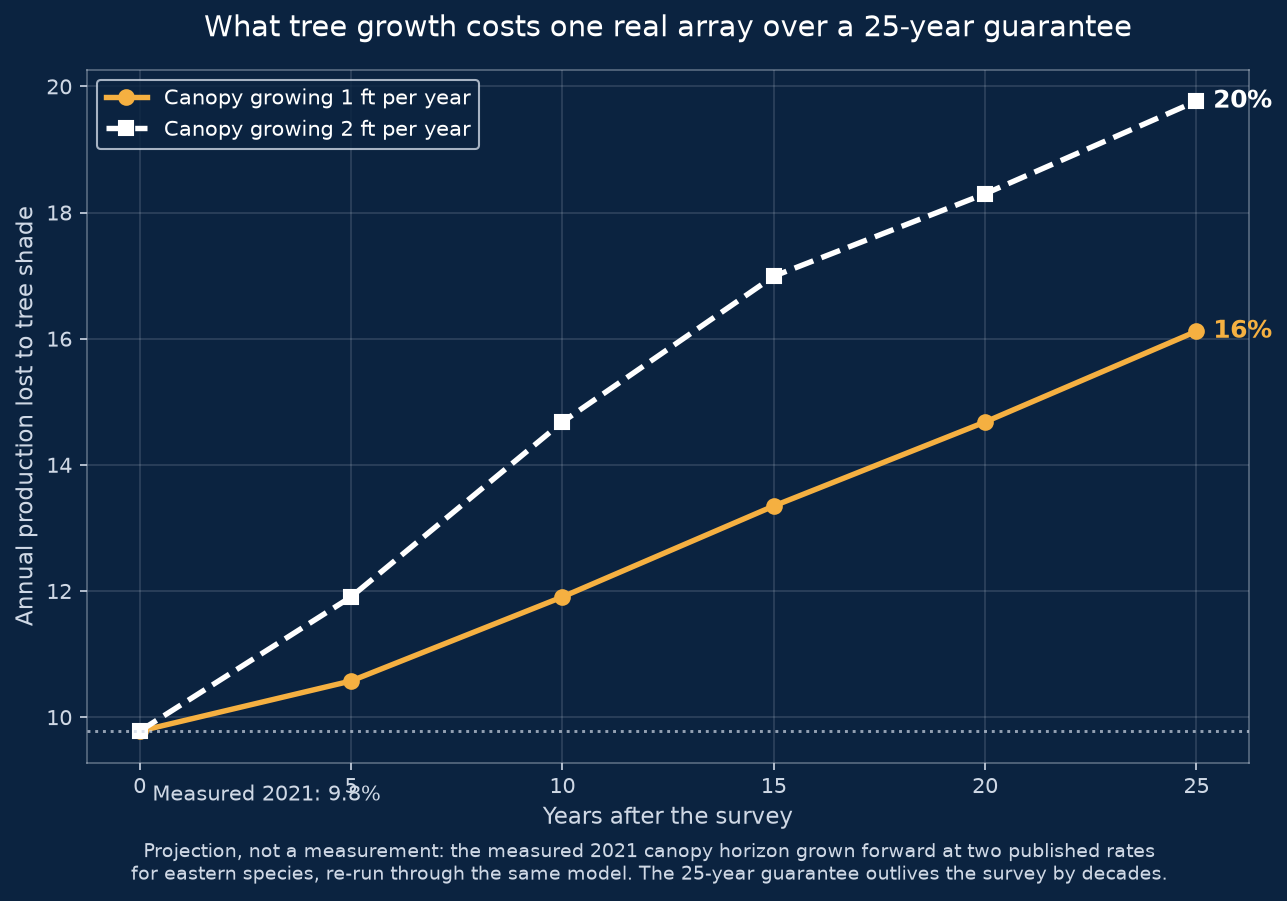
At one foot a year this system's shading loss rises by roughly two thirds across the guarantee term, from 9.8% to about 16%. At two feet a year it doubles, to nearly 20%. Neither line involves a single failing component.
That distinction matters commercially as well as technically. When production falls short, "your trees grew" is among the first things an installer will say, and it is often partly true. Almost nobody can say how much the canopy grew or how much of the shortfall it accounts for. Without that number, the argument is two opinions.
Federal USGS 3DEP LiDAR helps in a way that is not obvious. It covers most of the United States, records tree height, and much of it was flown years ago, frequently before a given system was installed. That makes it a baseline rather than a limitation. A baseline plus a current measurement is a growth rate, and a growth rate turns an assertion into arithmetic. For how the geometry works, see what decides whether a roof is good for solar.
How Degradation Affects Your Production Guarantee
If your installer provided a production guarantee, degradation is already built into the guarantee curve. The guaranteed production number should decrease each year at the stated degradation rate.
The risk is when your actual degradation exceeds the guarantee's assumed rate. If your guarantee assumes 0.5%/year degradation but your panels are degrading at 1.0%/year, you'll eventually fall below the guarantee threshold, but it may take several years for the gap to accumulate enough to trigger a claim. By then, the cumulative lost production can be substantial.
Early detection of excessive degradation lets you:
- File a manufacturer warranty claim sooner, before damage compounds
- Document the trend for your installer's production guarantee reconciliation
- Investigate the root cause (PID, microcracks, encapsulant failure) while the issue may still be partially reversible
How OwlWatt Tracks Degradation
OwlWatt compares your system's actual production to weather-adjusted expected baselines over time, calculating your system's effective degradation rate based on real performance data, not the manufacturer's spec sheet. When your measured degradation exceeds the expected rate, you get an alert with the estimated annual cost impact.
- Year-over-year performance ratio tracking that separates weather effects from system degradation
- Degradation rate calculation based on multiple years of weather-normalized production data
- Production guarantee integration that shows how actual degradation affects your position relative to the guarantee curve
- Dollar-denominated impact showing what excessive degradation costs you at your local electricity rate
Is Your System Aging Normally or Faster Than It Should?
For the plain-language version of this question (lifespan, what fails first, and how to read your own fade rate), see how long solar panels last.
OwlWatt tracks your solar system's actual degradation rate by comparing weather-adjusted production over time. Know whether your panels are aging as warranted, and catch accelerated degradation before it costs you thousands.
Sign up for OwlWatt and see how your system is aging.