 Owl
OwlIs My Roof Good for Solar? What Decides It
Most answers to this question are a sales visit and a number. The number holds up in summer and turns quietly optimistic in winter, and the single biggest factor is one almost nobody mentions: how big your roof is relative to what surrounds it.
The Four Things That Decide It
- Usable unshaded area. Count usable area after setbacks, vents, chimneys and fire-code pathways rather than total roof area.
- Orientation. South is best in the northern hemisphere. East and west give up roughly 10 to 20%. North seldom repays the outlay.
- Pitch. A moderate slope, roughly 20 to 35 degrees, is close to optimal at most US latitudes. Flat and very steep both cost output.
- What stands around it. Trees, neighbouring buildings, terrain. This is the one that gets estimated and never re-checked.
The first three are properties of the roof and do not change. The fourth grows about a foot a year.
Roof Size Matters More Than Tree Height
Take two buildings on similar wooded lots with similar trees. The larger roof loses very little output to those trees. The smaller one can lose a great deal. Across real measured buildings the spread runs from roughly 1% to over 30% of annual production. The trees themselves differ little between buildings. The spread arises because a bigger array puts more of its panels beyond the reach of the same treeline, and its centre sits further from the edge where shadows land.
So "will trees ruin my solar?" is the wrong question. The useful one is how much of my array can those trees reach, and when? That is geometry, and geometry is measurable.
What a Real Site Assessment Measures
A good assessment does not stop at "the roof faces south and there are some trees." It establishes a horizon: how high an obstruction stands in every direction around the array, in degrees above level. Combined with the sun's path at your latitude, that horizon determines exactly which hours of which days are shaded.
The next figure shows one measured from federal LiDAR on a real roof, not an illustration:
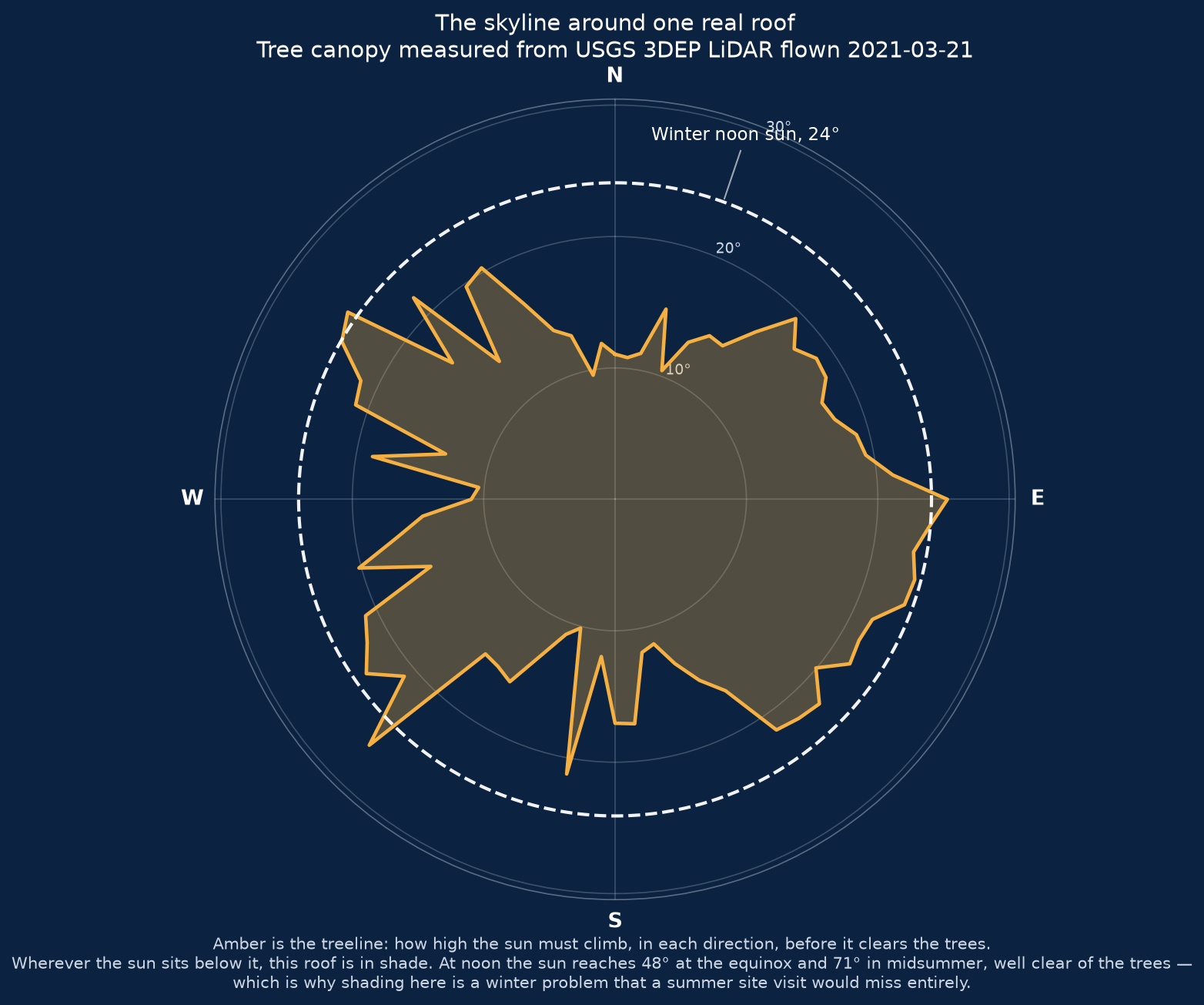
On this roof the treeline reaches 25 degrees to the east and sits near 17 degrees to the south. The winter noon sun at this latitude climbs to about 24 degrees. So in December the sun spends much of the day below the trees to the east, and this system's largest array happens to face east-north-east.
Why a Summer Site Visit Misses It
At around 42 degrees north the noon sun reaches roughly 71 degrees in midsummer and about 24 degrees at the winter solstice.
A treeline the summer sun sails over can block the winter sun for most of the day. An assessor standing on that roof in July sees an unobstructed sky and is not being careless. The sky is unobstructed, in July. The shadow arrives in November and nobody comes back to look.
The arithmetic is simple enough to do yourself. Shadow length is object height divided by the tangent of the sun's elevation. At 24 degrees that is 2.24 times the object's height. A 75 ft tree throws a 168 ft shadow at winter noon. At the equinox the same tree throws 68 ft, and in midsummer 26 ft.
Trees Grow, and Nobody Re-Measures
Eastern white pine adds roughly one to two feet a year. Over a 25-year production guarantee that is 25 to 50 feet of additional height on trees that were already measured once, before installation, by someone who has not returned since.
A shading estimate made at design time is a statement about the site as it was that year. It is not wrong. It describes a site that will not exist in a decade. And when production falls short, "your trees grew" is the first thing an installer says. Neither party can currently check that claim, because nobody measured the baseline in a way that could be compared later.
Federal LiDAR helps here. USGS 3DEP covers most of the country and records tree height, and much of it was flown years ago, often before a given system was installed. That makes it a baseline. A baseline plus a later measurement is a growth rate, which turns "your trees grew" from an assertion into a number.
So: Is Your Roof Good for Solar?
Probably better than a heavily wooded lot suggests, if the roof is large. Probably worse than a sunny summer afternoon suggests, if it is small and the trees are close. And the honest answer depends on measurements nobody hands you: usable area, orientation, pitch, and a horizon.
Frequently Asked Questions
Is my roof good for solar?
Four things decide it: usable unshaded area, orientation, pitch, and what stands around it. Roof area carries more weight than it appears to, because a larger array is proportionally less affected by the same surrounding trees.
Do trees ruin solar panels?
Seldom, and the honest answer is geometric rather than yes or no. What matters is how high the trees stand in each direction relative to the sun's path, and how much of the array they can reach. Measured losses across real buildings range from about 1% to over 30% on comparable wooded lots.
What does a solar site assessment measure?
Usable roof area, orientation and pitch, then the horizon: how high an obstruction stands in each direction around the array. That horizon plus the sun's path at your latitude determines which hours of the year are shaded.
Why does shading matter more in winter?
The sun sits much lower. At about 42 degrees north it reaches roughly 24 degrees above the horizon at winter noon against about 71 degrees in midsummer, so a treeline the summer sun clears easily can block the winter sun for most of the day.
Can I find out my roof's shading without a site visit?
Partly. Federal USGS 3DEP LiDAR covers most of the United States and records tree height, so a canopy horizon can be measured from public data. It measures the survey date, not today, which is why the survey date matters as much as the number.
Related Guides
- Solar Panel Efficiency Over Time
- Free Solar Production Calculator
- Weather-Adjusted Solar Production
- Solar Production Guarantees, Explained
- How OwlWatt Calculates Expected Production
Start with the number your roof should produce, then check it.
OwlWatt measures your actual production against a weather-adjusted physics model every day and documents any shortfall against your installer's production guarantee. Independent of your installer, and independent of the portal they gave you.